
What does wet soil have to do with birds?

What can the moisture level in the soil tell us about a birds flying over a solar park? At first glance, perhaps not much. But in an ecosystem, almost nothing exists in isolation.
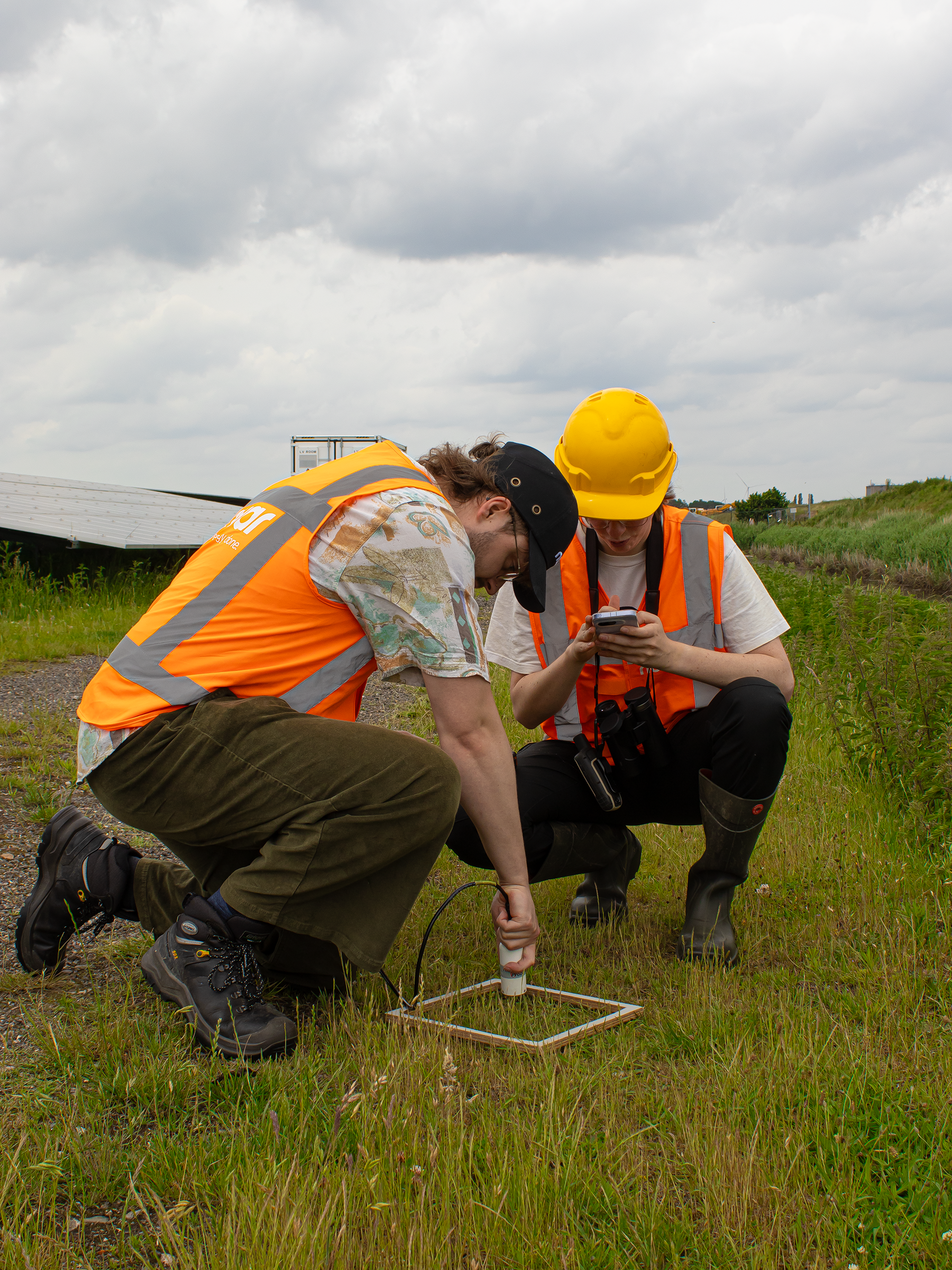
At the Nieuw-Buinen solar park, Julia, a student at the University of Groningen, is contributing to a five-year ecological study into solar parks. Her research focuses in particular on birds, including birds of prey and farmland birds, and on the habitat conditions that may influence where they occur. Together with Vincent, an ecology student at Novar, she is investigating how different parts of the ecosystem are connected. One of the measurements seems surprisingly simple: how wet is the soil?
Start with what is happening beneath your feet
The soil plays a major role in determining what can live in a particular place. Not only which plants can grow there, but also which animals can find a suitable habitat.
For small mammals such as mice, for example, it matters how wet or dry the soil is. In some places, they can create tunnels and burrows more easily than in others. Conditions in and on the soil therefore influence where they are able to settle.
This makes mice an important link between what happens in the soil and animals higher up the food chain.
They are an important food source for several birds of prey. If conditions in an area are favourable for mice, this may therefore also affect which birds of prey hunt there.
The step from soil moisture to a bird of prey may seem like a big one. But these kinds of connections are exactly what show how different parts of an ecosystem are linked.
Soil → habitat for mice → prey availability → birds of prey
One measurement does not tell the whole story
That does not mean that a single soil-moisture measurement can tell you how many mice live in an area or how many birds of prey, such as buzzards, use a solar park.
Ecological research is far too complex for that.
Weather, vegetation, management, the design of the solar park and the surrounding landscape can all have an influence. A dry patch of ground may appear suitable for mice, but that does not automatically mean they are actually there. And the presence of mice does not necessarily mean that a bird of prey will hunt in that exact spot.
The value therefore lies not in one individual measurement, but in combining different types of data.
By comparing soil conditions with information about prey animals and birds of prey, researchers can look for patterns. These connections help us better understand how a solar park functions as a habitat.
A solar park is more than what you can see above ground
When we talk about ecology at solar parks, the focus quickly turns to visible measures. Species-rich grassland, shrubs, flowers or nesting opportunities are easy to recognise. But an ecosystem consists of many more layers.
What happens below ground influences what grows above it. Vegetation provides food and shelter for insects and small mammals. They, in turn, form part of the food supply for birds and other animals.
Change something in one layer, and it can have consequences elsewhere in the system. That is why biodiversity research is about more than simply counting species. Just as interesting is the question of why a species occurs in a certain place and what conditions it needs to thrive there.
From a moisture meter to a bigger story
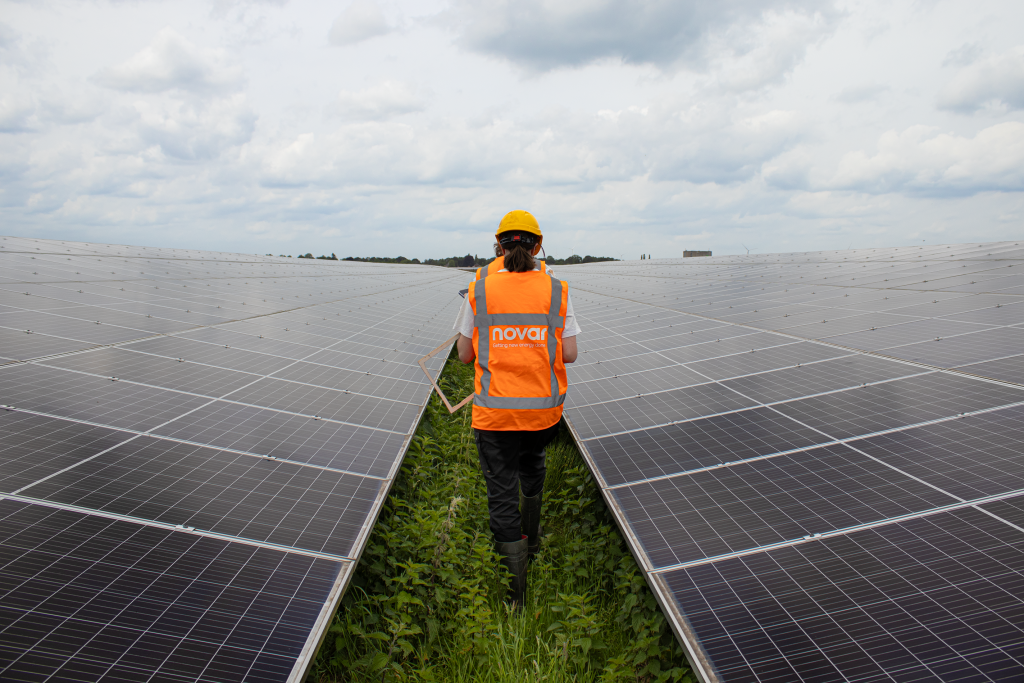
In the field, research like this can start surprisingly small. Walking a route. Selecting a measurement point. Pushing an instrument into the ground. Recording the soil moisture.
On its own, a number like that tells you very little. But when the same measurements are taken at multiple locations and combined with other ecological data, a bigger picture gradually begins to emerge.
Perhaps certain parts of a solar park turn out to be more attractive to mice. Perhaps that is connected to the soil, vegetation or amount of shelter available. And perhaps that can then help explain why a farmland bird uses certain parts of the site and avoids others.
Those are exactly the kinds of connections researchers are looking for.
Building a better understanding of what is happening
Research into ecology at solar parks is still relatively young. There is no simple blueprint for what a solar park should look like in order to work well for every species. That is why studies like these matter. They help reveal the relationships within a solar park and the factors that influence them.
Not every measurement immediately provides an answer. Sometimes research mainly leads to a new question. But by continuing to zoom in and connect different parts of the ecosystem, researchers can gradually build a clearer picture of what is really happening between and beneath the solar panels.
And sometimes, that bigger story starts with something as simple as a patch of wet soil.